Hanukkah: eight nights, a personal wish
A little context for the festival of lights, and thoughtful ways to greet the people who celebrate it.
Light with a particular meaning
Hanukkah commemorates the rededication of the Temple in Jerusalem. The Smithsonian describes the tradition of oil that was expected to last a single day lasting eight days instead. This story is connected with the holiday’s eight-night celebration.
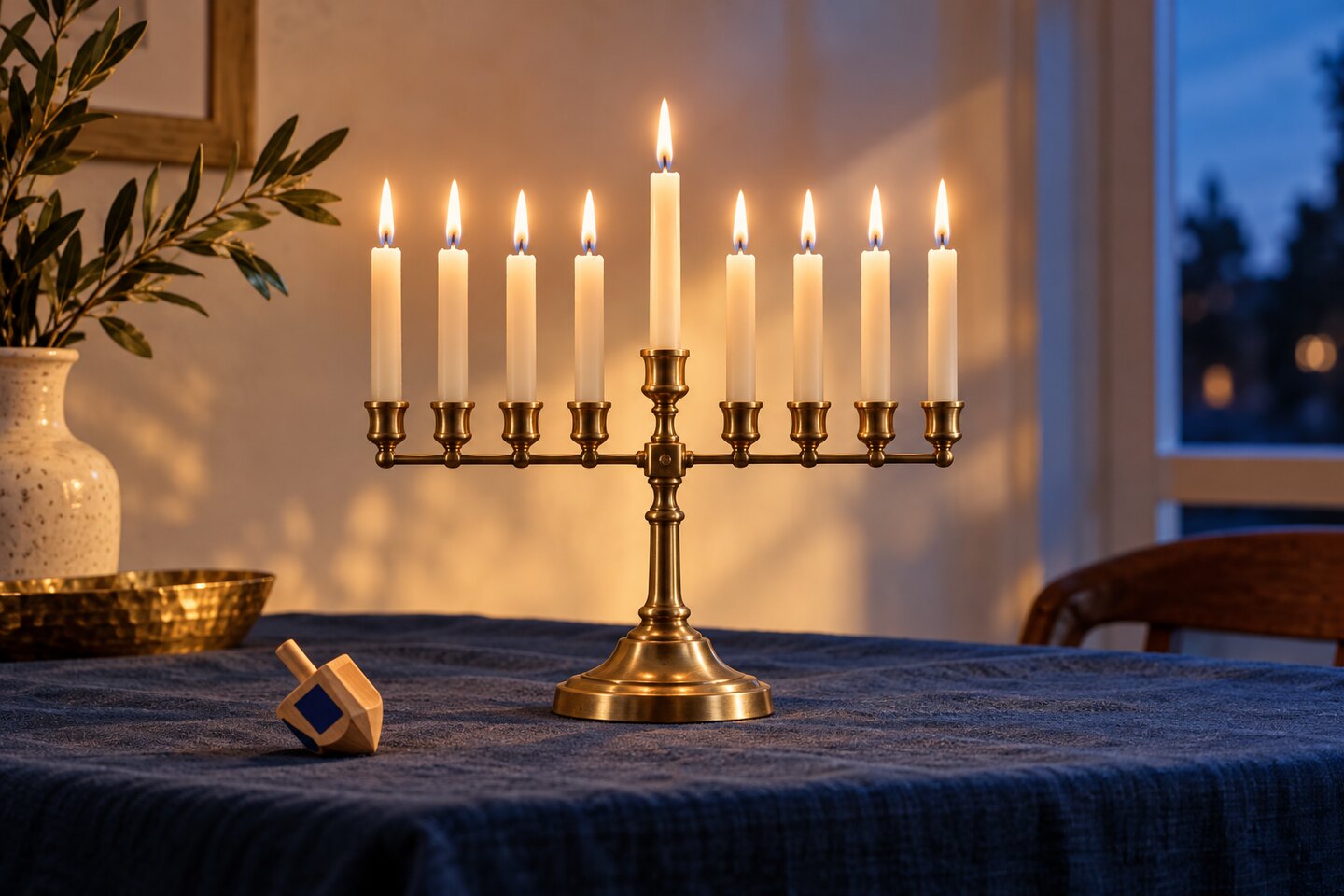
The Hanukkah lamp has space for eight lights and a separate shamash used to light the others. It is different from the seven-branched menorah. Our cover is AI-created inspiration showing all eight lights and the shamash lit; it is not a guide to the lighting sequence.
History, remembrance and the story of the oil
The National Library of Israel places Hanukkah in the history of the Hasmonean revolt against the Seleucid Empire and the rededication of the Temple. It also notes that there are several explanations for the festival’s eight-day length. Historical events and later religious interpretation should therefore be distinguished rather than flattened into one simplified account.
The oil lasting eight days is a religious tradition associated with the festival. When telling the story, identify it as tradition rather than presenting a miracle as a claim established by modern historical evidence. This leaves room for both the history and the meaning it holds for people who celebrate.
Context source: National Library of Israel — Hanukkah ↗
Look closely at the lamp
The Smithsonian American Art Museum’s collection entry describes eight lights of equal height and a separate, taller shamash. Its particular lamp uses oil wicks, a useful reminder that candles are not the only material form a Hanukkah lamp can take. The object is both a functional ritual item and a work of design.
For greeting artwork, that distinction has practical consequences. Check the number of lights and avoid substituting an unrelated seven-branched lamp. A decorative image showing every light burning represents a different moment from the first evening. The cover on this page is illustrative and is not a set of instructions for observance.
Context source: Smithsonian American Art Museum — Hanukkah Menorah ↗
A note for someone you know well
A personal greeting can begin with a remembered evening rather than a lesson about the holiday. “I miss being at your table and hearing everyone’s stories” speaks from your own experience. Follow with a simple wish for a happy Hanukkah. You do not need to add Hebrew if you are unsure of the wording or cannot review it.
If you are including a family photograph, ask which elements should stay recognizable. A cherished lamp, a handmade decoration or the room where people gathered may be more meaningful than an invented luxury setting. Make clear whether you want to preserve the original snapshot or create a new imagined scene inspired by it.
For a colleague or neighbor, keep the message easy to receive: a warm acknowledgment without assuming how observant they are. If you have been invited to a celebration, a thank-you afterward can mention something you appreciated about the welcome. Let the person choose how much they want to share about their traditions.
Follow the household’s own celebration
A family photograph, a familiar lamp or a memory of an evening together can give your greeting a personal starting point. Ask which spelling and language your recipient prefers. Hanukkah and Chanukah are both commonly encountered spellings.
Use the calendar for planning, and remember that observance begins at sunset. Do not assume that a daytime date label describes the beginning of the first evening for every location.
Keep the message warm and specific
For a close friend, mention something you hope to share: a visit, a conversation or another evening together. For a colleague, a simple wish for a happy celebration can be thoughtful without borrowing religious language you do not know well.
Avoid presenting Hanukkah as a version of Christmas. Let the recipient’s own traditions set the scene and choose the message for the relationship you actually share.
A little starting inspiration
For family: “Wishing you eight nights of warmth and many happy moments together. Happy Hanukkah!”
For a friend: “Thinking of you and wishing you a joyful Hanukkah.”
These are original message suggestions. Add a name, a memory or an inside joke to make yours personal.
Create a Hanukkah greeting →Common questions
Does a Hanukkah lamp have seven or nine lights?
A hanukkiah has eight festival lights plus the separate shamash, for nine positions. It should not be confused with the seven-branched menorah.
Can I send a greeting without being Jewish?
A respectful personal wish can be appropriate when you know the recipient celebrates. Keep it warm, avoid assumptions and follow their preferred wording.
Sources & further reading
Historical context is summarized from the resources below. Our suggested messages and celebration ideas are original editorial suggestions.
Prepared with AI assistance and source checks on October 18, 2026. No specialist or community review is claimed. Traditions can vary; follow your recipient’s preferences. Historical context and original writing suggestions are distinguished in the text.